Tire Tips & Buying Guides
Cold Doesn't Hurt Your Rubber Tracks. Here's What Does.
A 50-cent paper towel can save a $20,000 rubber track. That's not a gimmick — it's the cheapest early-warning system you'll ever put in a farm shop.
Every fall, machines get parked for the winter. Every spring, some of them don't come back the way they went in. The track gets the blame. But in most cases, the track was never the problem. What failed was everything around it.
Cold Doesn't Hurt Tracks. It Hurts What's Under Them.
In the continental U.S., every seasonal low falls inside the design envelope of a modern rubber track compound. The rubber itself is built for it.
What cold damages is the undercarriage: hubs, seals, bearings, and the hydraulic tensioning that lets a track move. A seal that weeps all winter, a bearing that runs dry, or mud frozen solid in the roller path — that's what turns a spring start-up into a $20,000 service call.
The good news: all of it is preventable with a 15-minute shop visit before the machine gets parked.
Before Storage: The Five-Step Shop Visit
Run every machine through these five steps before it gets parked for the season.
- Clean the undercarriage. Pressure-wash mud, crop residue, and anything packed into the roller path. Wet material dries into something like concrete and freezes solid — and frozen material in the roller path puts the track's main cables under overload the moment the machine starts.
- Top off every hub oil. Verify levels now. This becomes your baseline. If any oil is missing in spring, you know a seal failed in storage.
- Mark each hub with a white paint marker and today's date. In spring, the operator can see at a glance which hubs were checked and when.
- Lay a white paper towel under each hub. Weigh it down with a small rock if needed. Any seal that drips over the winter will stain that towel. Oil on the towel means a failed seal; a clean towel means a healthy hub. This is the $0.50 trick that catches a $20,000 problem.
- Store under cover. Inside is best, then a lean-to, then a tarp, with open sky as the last resort. UV and ozone degrade rubber all winter, even in cold storage.
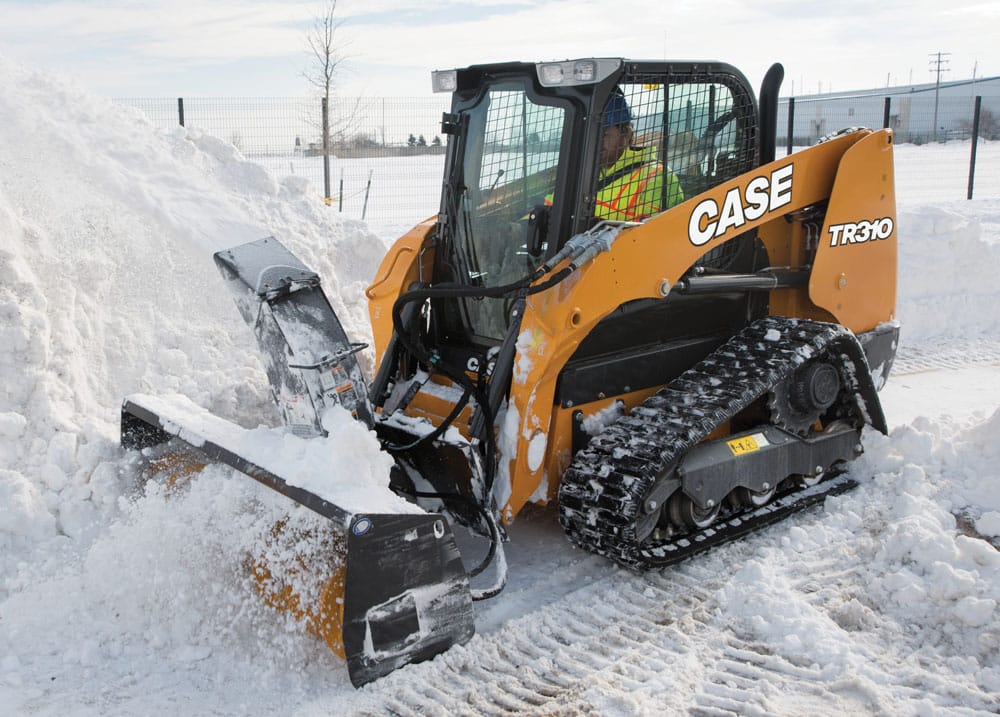
Still Running? The End-of-Day Winter RoutineNot every machine gets parked. For dirt work, snow removal, and winter site jobs, end-of-day cleanup is non-negotiable. Frozen mud in the roller path is what snaps main cables when the machine fires up the next morning.
- Rinse the undercarriage. Clean out mud and debris before it freezes solid overnight.
- Drive 50 feet to shed water. This breaks loose anything clinging to the roller path.
- Park on dry ground. Gravel or concrete, never standing water or mud.
- Walk the undercarriage before morning start-up. "Driving it loose" is how tracks get snapped.
- Let hydraulic fluid warm before gearing up in deep cold.
Before First Spring StartThis is where the fall prep pays off. Before anyone turns the key:
- Inspect each paper towel. Collect them before the machine moves. Oil residue means a failed seal at that hub.
- Verify each hub oil level. Compare it to the October date written on the hub.
- Treat any oil loss as a seal service before use. Do not run the machine. A locked bearing in the field destroys the whole track.
- When uncertain, call your dealer. A $200 preventive fix beats a $20,000 field failure.
The Winter Storage & Operation Checklist
The five-step storage protocol plus the end-of-day winter-operation steps, formatted as a one-page print-ready checklist for the farm shop wall.
Everything You Need to Know About Tractor Tires
Types of Tractor Tires
There’s no such thing as one-size-fits-all tractor tires. A single farm can have loose, soft soil, hard-packed soil, rocky ground, pavement, and well-manicured grass. Each surface requires different types of tractor tires for optimal traction, and the properties that make a tire perfect for one will be unsuited for the next.
Since purchasing tractor tires is a long-term investment, it pays to carefully consider which tires will give you the best performance.
Agricultural Tires
If you’re picturing “tractor tires” in your mind, you’re likely thinking about agricultural tires. These tires have diagonal, widely spaced lugs that angle toward the center of the tread. Their design channels loose dirt, sand, and mud to avoid clogging and reduced traction. The treads can dig deep and reach firmer ground to improve handling.
Also called “ag tires,” agricultural tires come in several types.
R1
With a lug height of around 1 ½ inches, R1 ag tractor tires provide excellent all-around performance in the type of soil typically found in a rural or agricultural setting.
R1W
For improved traction in wet conditions, R1W tires extend the depth of the lugs by 20%.
R2
These are the most extreme ag tires, featuring lugs with twice the depth of R1 tires. Typically, R2 tires are used in the wettest terrain, such as rice paddies.
Turf Tires/R3
Tractor tires intended for use on grass and turf must provide secure traction without harming the ground. Turf tires, or R3 tires, feature wide, shallow treads with tightly packed lugs. By spreading out the weight of the tractor, these tires provide minimal soil disturbance yet still have enough tread for decent grip.
Where R3 tires are not suitable is in snow and mud. The treads will rapidly become clogged, making the tires too slick to move the tractor.
Industrial Tires/R4 Tires
Heavy machines such as wheel loaders operate on hard earth, gravel, and paved surfaces, which is why industrial tires, also called R4 tires, have thick, robust sidewalls and large, narrowly-spaced tread blocks.
In general, users can expect long lifespans from their R4 tires. Their rugged, durable, hard rubber compounds resist wear and punctures. However, these tires are not designed to handle deep, soft soil and can get stuck if the terrain is too muddy or wet.
Specialty Tires
For tractors that have to traverse specific conditions, standard tires may not be ideal. In these cases, users may need one of the following.
Snow Tires
With soft rubber compounds that stay flexible in cold weather and aggressive treads that channel snow and ice, snow tires can offer dry-weather performance through heavy precipitation.
Flotation Tires
These tires offer excellent traction in sand and loose sediment. They are exceptionally wide to create the largest footprint possible, spreading the tractor’s weight over a large area. This reduces soil compaction and disturbance to avoid creating ruts.
Hybrid Tires
To create more versatile tractor tires, manufacturers have combined the durability of industrial tires with the traction of farm tires. This allows machinery to traverse from one surface to the other without sacrificing performance.
Understanding Tractor Tire Sizes
When purchasing tractor tires, you need to make sure they’ll fit your tractor. There are two main measuring systems — metric and standard.
Metric
If your tire size is 450/85R30, this corresponds to:
- Width: 450 millimeters
- Aspect Ratio: Height is 85% of width
- Construction: R for “radial”
- Rim Diameter: 30 inches
The tire may also have a load index or ply rating. These indicate the amount of weight the tire can handle. After this may be a speed index, which shows the tire’s top speed. Finally, the tire can display the tread style, such as R1, R2, etc.
Standard
Let’s say your tire size is 18x8.50-8. This corresponds to:
- Height: 18 inches
- Width: 8.5 inches
- Rim Diameter: 8 inches
The hyphen between the final two numbers indicates that the tire is bias ply construction. If there’s an R, it’s a radial tire. There may also be an “L” after the first number, indicating a reduced aspect ratio.
To measure your tractor tires, start with the rim width. Measure from the inside of the bead lip on one side of the tire to the inside of the bead lip on the opposite side. For diameter, measure from the flange of the bead lip on one side of the rim to the other.
Common tire sizes include:
- 7.50-16
- 11L-15
- 13.6-28
- 18.5R38
Typically, smaller tires, such as the 7.50-16, will be used as front wheels for a larger tractor or rear wheels for a smaller tractor. The larger the tractor tire, in general, the larger the tractor. The tire needs to be stronger to withstand the extra weight.
Factors to Consider When Choosing Tractor Tires
Buying new tractor tires isn’t cheap. Consider them an investment, so choose wisely, taking into consideration:
- Terrain and soil type
- Tractor type and load capacity
- Weather conditions and seasonal usage
- Cost vs. performance
One aspect that can dramatically impact how your tires behave is whether they are bias ply or radial. Bias-ply tires tend to be much cheaper and have strong sidewalls, but they offer poor handling and decreased longevity.
Radials have dramatically improved handling characteristics and a long lifespan but are more expensive than bias-ply tires and require strengthened sidewalls to avoid punctures.
When to Replace Your Tractor Tires
Unfortunately, your tractor tires won’t last forever. To know whether they need replacement, look for several signs.
Wear and Damage
Inspect your tires for cracks, broken lugs, punctures, and exposed plies.
Poor Performance
Once your tires stop gripping well or exhibit negative handling characteristics, they may be too far gone.
Age
In general, a radial ag tire should withstand between 3,000 to 5,000 hours of use. Bias ply ag tires typically handle 2,000 to 3,000 hours. Regardless of use, most tires will need to be replaced after around eight years due to the rubber hardening or rotting.
Why Buy Tractor Tires From Us?
Purchasing from Tires4That doesn’t just get you new tractor tires; it’s also how you make a long-term tire supply partner!
We have decades of knowledge that can help you make smart tire-buying decisions, whether you’re purchasing for a small lawn tractor or a fleet of heavy machinery. Check out our gigantic selection of farm tires and contact Tires4That today!
onTypes of ATV Tires
Main Types of ATV Tires
Since “ATV” is short for “all-terrain vehicle,” it stands to reason that the vehicle should be suitable for all terrains.
However, just because the ATV itself can handle any type of ground you throw at it, that doesn’t mean its tires are up for the challenge. That’s why choosing the right kinds of ATV tires is so important. The tires are the first point of contact, determining whether your ATV will glide effortlessly across the surface or struggle to move an inch.
Which types of ATV tires are right for you depends on where you’ll be riding your ATV, and the names of the tires will clue you in on their purpose. Learn more about why each tire is designed the way it is.
Mud Tires
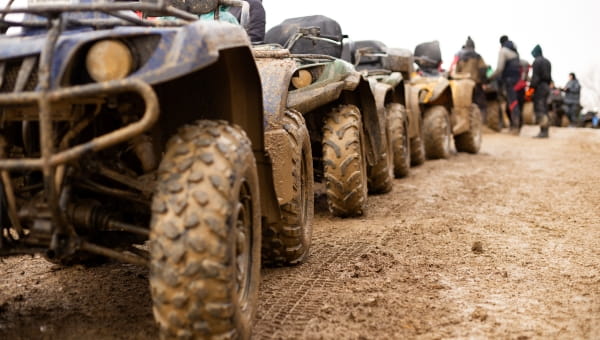
Traversing muddy terrain requires aggressive treads, and mud tires feature some of the most exaggerated treads of any design. Their tall lugs are spaced far apart to funnel mud through large voids and away from the tire. Essentially, the lugs act like paddles pushing a boat through water, which allows them to have an incredible grip in the deepest muck.
Pros:- Secure traction in deep mud
- Self-cleaning
- Mud tires are heavy, which puts stress on ATV components
- Poor traction and ride on harder surfaces
- May require lifting or spacers to fit on the ATV
These types of ATV tires are best suited for swamps and other muddy, wet environments.
All-Terrain Tires
These are among the most common types of ATV tires because, as the name implies, they offer solid performance on most surfaces. They may not be as good in mud as mud tires or as good in snow as snow tires, but all-terrain tires perform well enough in all conditions to be excellent all-rounders.
The lugs are shorter and more tightly packed than mud tires, but still have more aggressive treads than the all-season tires found on the average car.
Pros:- Can handle a wide variety of surfaces
- Wide use means plenty of choice of brand, size, and tread design
- Long-lasting
- Smooth ride
- May not handle specific surfaces as well as specialty tires
All-terrain tires can handle rocky terrain, gravel, and shallow mud, offering stable handling on a wide variety of terrain. They’re less suited for deep mud or sand.
Sand Tires
Rear sand tires are the drive tires, the ones that propel the ATV forward. They feature sparse paddle-like treads with vast voids in between. Front sand tires are nearly tread-free and use only one or two ridges to give the ATV directional stability.
These types of ATV tires are highly specialized and should only be used in sand. If used on any other kind of terrain, the result will be a terrible ride and damaged tires.
Pros:- Provides stable, secure handling in loose sand
- Not suitable for any environment other than sand
- Requires different tires for front and rear
Whether you’re riding on a beach or in a desert, sand tires can give your ATV the traction it needs.
Trail Tires
Like all-terrain tires, these types of ATV tires are jack-of-all-trades that prioritize versatility. They offer secure footing on forest paths and gravel and are good enough for light off-roading.
Tread designs can vary greatly, and some even push their patterns toward one type of terrain over others, though manufacturers are careful not to compromise their tires’ performance on other possible surfaces.
Pros:- Designed to work as well as possible on the widest array of terrains
- Good traction without sacrificing ride quality
- Excellent longevity
- Won’t handle the deepest, most challenging mud, snow, or sand
Use these tires on dirt trails and mixed natural terrains where the surfaces don’t become too extreme.
Racing Tires
These are the types of ATV tires users buy when speed is the main consideration. For motocross sports that race on medium to hard-packed earth, racing tires offer tenacious grip thanks to their hard rubber compounds and stiff, short, knobby lugs with square edges. Voids are small to create the largest possible contact patch.
Stray too far from the target terrain, and ride quality will suffer, however. Traction will be in short supply in mud, snow, and sand. Additionally, the hard rubber compounds and stiff treads will make riding on the pavement quite noisy while proving mediocre adherence.
Pros:- Allows for high-speed handling and stability on specific surfaces
- Harder rubber compounds translate to less wear
- Poor traction outside of motocross/ATV racing environments
Use these tires only on tracks designed for motocross and ATV racing, and they’ll serve their purpose well.
Snow Tires
While many ATV owners forego these types of ATV tires because mud or trail tires are “good enough,” snow tires offer superior traction.
There are two main types of snow tires — one that provides traction through paddle-style lugs and one with more conventional all-terrain-style lugs, though widely spaced for channeling snow. This second type may even feature holes for adding studs to aid in traction on ice.
The paddle-lugged tires are designed for gripping powdery snow. Both feature softer rubber compounds designed to withstand extremely cold temperatures
Pros:- Provides excellent grip on snow and ice-covered surfaces
- Designed to handle extremely cold temperatures without cracking or hardening
- Poor traction on surfaces other than snow and ice
- Not designed to withstand high temperatures
- Buyers must choose between tires for powdery snow or ice/hard-packed snow
These types of ATV tires should only be used in snow and ice.Using snow tires in warm, dry conditions will cause them to wear out quickly, not to mention the handling and ride quality will be poor.
Why Buy Tractor Tires From Us?
Tires4That knows tires inside and out, no matter the vehicle or purpose. We’ve become a trusted tire supply partner for people around the world, and we look forward to partnering with you!
Shop our comprehensive selection of tires and get the traction you need for the terrain you face. If you’re having trouble deciding which tires are right for you, don’t hesitate to reach out to the tire experts at Tires4That!
onTractor Tire Size Guide: Everything You Need to Know for Optimal Performance
Understanding Tractor Tire Size Notation
Before diving deeper into the tractor tire size guide, it’s important to understand tire size notation. Deciphering tire size notation can feel like translating a foreign language. Like car tires, tractor tire sizes come in metric and standard formats. Each notation part conveys essential information about the tire’s dimensions and application.
Since tractor tires often use a combination of metric and standard (inch-based) measurements, you need to know what size notations might look like. For example, a common tire tractor size notation may appear as follows: “18.4-38” (standard) or “460/85R38” (metric).
In the standard format, “18.4-38” represents the following:
- Width: 18.4 inches, conveying the width of the tire
- Aspect Ratio: Not always displayed, but it typically indicates the sidewall height as a percentage of the width
- Rim Diameter: 38 inches, representing the diameter of the wheel rim
In the metric format, “460/85R38” means:
- Width: 460 millimeters
- Aspect Ratio: 85% of the width
- Construction: The “R” stands for radial construction
- Rim Diameter: 38 inches
Each part of the tire size notation is designed to help you better understand the tire’s fit and performance. The width influences how much ground it covers. Wider tires are typically better for traction and flotation on soft surfaces.
The aspect ratio indicates the height of the sidewall in proportion to the tire width. A lower aspect ratio typically means better stability, whereas higher ratios can bring more cushioning and flotation. The rim diameter is relatively simple. It helps determine whether the tire is compatible with your tractor’s wheel.
Now, it’s time to get into the rest of this tractor tire size guide.
Types of Tractor Tires and Their Size Considerations
No tractor tire size guide is complete without a breakdown of different tractor tire categories. The type of work you do with your tractor will influence the kind and size of tire you need. Here’s a deep dive into the many types of tractor tires and the sizing considerations for each.
Agricultural Tires (R1)
R1 tires are designed to provide good traction in soil. They are ideal for fieldwork or general farming tasks. Agricultural tires typically have a deep tread pattern to maximize grip on loose soils. You can purchase R1 tires in varying widths and heights to achieve better flotation in soft fields.
Industrial Tires (R4)
R4 tires are designed for construction and mixed-surface applications, which means they are sized with stability and durability in mind. R4 tires often have a more shallow tread than R1 tires and are built to handle heavy loads and harsh surfaces, such as concrete and gravel.
Turf Tires (R3)
R3 turf tires are ideal for lawn and landscaping due to their low-profile tread patterns. Sizing considerations for turf tires focus on ground contact area and weight distribution to protect delicate grass surfaces.
How to Measure Tractor Tires Correctly
Measuring your tires correctly is one of the most important parts of our tractor tire size guide. You must ensure that your tires can handle your tractor’s load requirements and intended use case. There are a few factors to consider here, including ply rating, load capacity, and construction (bias vs. radial).
The ply rating of a tractor tire indicates how strong it is and how much weight it can handle. A higher ply rating means the tire can support more weight. Bias-ply and radial tires are two construction types with different benefits and sizing considerations.
Bias-ply tires have overlapping layers, making them durable and more affordable. However, you may be in for a bumpy ride. Radial tires provide better traction and longevity. They are more expensive than bias-ply tires.
Choosing the Right Size for Different Tractor Applications
Our tractor tire size guide can help you match your tire choices with the intended application of your machinery. If you are going to be doing a lot of fieldwork, you’ll need larger tires with increased width and flotation properties. They help spread the tractor’s weight over a larger area and reduce soil compaction.
If you’re using your tractor for loader work or on construction sites, you need tires that are stable under heavy loads. Consider an option with a higher ply rating and durable construction.
In contrast, if you’ll be performing a lot of lawn and turf work, smaller, low-profile tires are recommended. These protect the ground surface from damage and offer smooth traction.
Why Buy Tractor Tires From Us?
That wraps up our tractor tire size guide. Now that you know how to choose the right type and size of replacement tires for your equipment, it’s time to find a reputable provider. Tires4That has you covered. Use our tractor tire size guide to find high-quality tire options. Explore our wide selection of farm tires and place your order today.
If you need personalized assistance, simply connect with our team. We can help you identify the right tire options based on the make and model of your tractor, as well as your intended use case.
onTypes of Tractor Tires: Choosing the Right Tire for Every Job
Agricultural Tires (R1)
Agricultural tires, or R1 tires, are among the most common types of tractor tires. They are sometimes referred to as “lug” tires. Agricultural tires are built for the demands of farming and fieldwork. They are engineered for maximum traction, making them ideal for loose and muddy soil as well as rough terrain.
R1 tires are designed to cut into the soil so that tractors can plow, till, and navigate muddy conditions without losing grip. Here are some of the key features of R1 tires:
- Deep, Angled Tread: Designed for maximum traction, especially in soft soil and mud
- High Flotation: The wide surface area helps distribute weight evenly, minimizing soil compaction
Agricultural tires excel in fieldwork like plowing and tilling. They’re also well-suited if you require stable performance on uneven ground.
Industrial Tires (R4)
Industrial tires, or R4 tires, are versatile, all-purpose tires designed for industrial applications. They are heavily used on loaders and backhoes. R4 tires are built for durability and stability on hard surfaces, whereas agricultural tires might wear down too quickly.
The key features of industrial tires include the following:
- Heavier Tread: Offers durability on hard or rocky surfaces
- Higher Ply Rating: Reinforces the tire to support heavy loads, making it ideal for loader work and construction tasks
Industrial tires are best suited for construction, landscaping, and applications involving hard surfaces or a mix of terrain types. You can install R4 tires if you frequently switch between field and road work. They will provide stability on hard surfaces without sacrificing too much traction in softer soils.
However, you may want to avoid R4 tires if you are working on exceptionally soft surfaces where flotation properties are needed. The dense, rugged design of R4 tires reduces their flotation properties compared to agricultural tires.
Turf Tires (R3)
Turf tires, or R3 tires, are engineered for uses that demand delicacy and gentleness. If you’ll be working on grass and soil that needs to be left as undisturbed as possible, turf tires are your best option. Golf courses are a prime example of a surface that would require R3 tires.
There are several types of tractor tires designed for turf, but all models have some common features:
- Shallow, Wide Tread Pattern: Reduces soil and grass damage
- Wide Surface Contact: Distributes weight over a larger area to avoid rutting or compressing
Turf tires are perfect for lawn care, sports fields, and landscaping. They will preserve the surface you are working on. However, R3 tires provide very little traction due to their shallow tread pattern.
As a result, they are unsuitable for use on soft surfaces or rugged terrain. R3 tires will also wear at an accelerated rate if used on hard surfaces like asphalt or gravel.
Flotation Tires
As the name suggests, flotation tires are designed to float over the ground. They are built for soft ground and wet conditions where regular tires would sink or cause ground compaction.
These tires have a large, extra-wide surface area. They’re ideal for sandy soils or wet fields, providing minimal ground disturbance and preventing tractors from sinking. Some of the notable attributes of flotation tires include the following:
- Extra-Wide Profile: Provides a large surface area to prevent sinking
- Large Contact Patch: Reduces pressure on the ground to protect sensitive soils
You can use flotation tires to haul heavy loads over soft ground, something traditional tires would struggle to do. However, it’s important to verify that your tractor has enough spacing and fender clearance to accommodate the larger, taller tires. If you need flotation tires but your tractor can’t use them, you may need to make modifications.
Specialty Tires
There are also several types of tractor tires designed for niche use cases. Some examples include:
- Row Crop Tires: Narrow option designed to move precisely between rows in crop fields, minimizing crop disturbance
- Forestry Tires: Heavy-duty tires offering excellent durability and puncture resistance
- High-Speed Radial Tires: Provide a smoother, more efficient ride on the road for tractors that need to travel between job sites quickly
Choosing the Right Tire for Your Tractor’s Needs
With so many types of tractor tires available, it can be tough to identify the right option for your tractor and situation. Choosing the wrong types of tractor tires can lead to poor traction and unnecessary wear. You may even damage the surface you are working on or increase the risk of an accident.
To narrow your choices, you need to consider the following elements:
- Terrain: Where you’ll be using your tractor most often
- Application: What type of work you’ll be doing (e.g., loading, tilling, etc.)
- Load Capacity: How much you need to carry (if you’ll be using heavy attachments or hauling, choose a tire with a high ply rating)
- Budget and Longevity: How much you can afford vs. how long you need it to last (consider that ag tires tend to be more affordable, while R4 tires last longer)
Find a tire that offers the ideal combination of longevity, affordability, load capacity, and features. While you don’t need to buy the most expensive tire out there, you shouldn’t skimp on quality, either. Investing in a good quality tire that’s designed for your use case will provide the best long-term value.
Why Buy Tractor Tires From Us?
Tractors are among the most versatile pieces of machinery in use today. However, the right tire is essential for maximizing your tractor’s performance and efficiency. There are several types of tractor tires available, and each is designed to handle specific terrains and load requirements.
Tires4That carries all types of tractor tires from reputable manufacturers. You can filter types of tractor tires in our catalog by use case, rim size, width, and more. Our interactive catalog makes it easy to identify the right option for your situation.
Explore our selection of farm tires, or contact our team for personalized assistance. We look forward to helping you find the right types of tractor tires for your farm equipment.
on3 Tips You Need to Know When Shopping for Specialty Tires
One subject we know like the back of our hand here at Tires4That.com is specialty tires. For years, we have been dedicated to assisting customers with top quality tires at great prices.
Our customers will always come first at Tires4That.com. Aside from providing our customers with excellent customer satisfaction and a product they can depend on, we also help make our customers more knowledgeable about all things specialty tires. Our Tire University page on our website informs our readers on a wide variety of tire types. ATV tire measuring, tire tread classification, tire measuring and wheel measuring are just some of the topics customers can read up on at Tire University.
Since specialty tires can be much different compared to everyday vehicle tires, we thought we'd let our readers know about a handful of valuable tips when shopping for specialty tires
Not All Tires Are the Same
- Tread Designs - Even if two or more tires are made by the same manufacturer, that doesn't mean that the tires tread designs are compatible. Most specialty tires are designed for major equipment. Because of that, they are designed with specific tread designs and a certain height and width.
- Sizing - Just because a tire is marked with the same size on the sidewall, doesn't mean that they have the same height and width. Many tires are made in a manufacturer's own plant. However, many tires are outsourced to other countries and may not line up with their standards.
- Import vs. Domestic Brands - Specialty tires are manufactured all over the world. The quality of tire can vary from brand to brand. Similar to the sizing issue, tires with the same size markings may not always match up. Imported tires can also be smaller in size.
Not All Tires Do the Same Thing
Specialty tires get their name because they are designed for a specific application. Specialty tires are designed for a specific working condition, environment and carry different amounts of weight. Because of this, some tires outperform other tires. Just because a tire works well for one application, doesn't mean it will work well for a similar purpose.
Take Care of Your Tires
Many people believe that over-inflating or under-inflating a tire can change the performance of a tire. Under-inflating a tire will not allow it to carry as much weight as stamped on the sidewall. Over-inflating won't allow the tire to carry more weight either. The right air pressure is important to getting the best performance out a tire. Proper air pressure also extends the duration of a tire’s use.
Anyone interested in ordering specialty tires should contact our team here at Tires4That.com by calling (866)764-4651.
onEasy Safety Tips for ATV Trail Riding
Fall is right around the corner, and aside from the leaves changing colors and the temperatures dropping, we also get to partake in various activities that wouldn’t be as much fun during the summer -- ATV trail riding being one of them. Before packing up the truck and heading up to your favorite trail, you're going to want to make sure your ATV, UTV or Side by Side is in good condition, starting from the tires up. Anyone who comes across a problem with their tires can shop with the experts at Tires4That.com. The company specializes in being a leading provider of specialty tires.
Safe trail riding starts with proper care of the bike or ATV you’re riding on. From there, there are specific actions or precautions riders can take to minimize their chance of crash and injury. Here care five quick and easy tips to help you become a safer rider.
- Wear Gear - This one might come off a no-brainer, but the easiest way to avoid injury is to wear the proper safety equipment. Regardless of how long or short you plan on riding, safety equipment should be worn at all times. Flipping and falling off an ATV is a lot easier than you might imagine. Wearing a helmet and goggles should become second nature to an experienced ATV rider.
- Don’t Ride Alone - Any activity that has a chance for injury should never be performed alone. Having a riding buddy or two is the best way to prevent further damage from happening. Even the safest rider can still suffer an unexpected injury and/or accident. Having an accident take place with no one else around would prove to be very problematic.
- Inspection - Making sure you give a quick inspection of your ATV or UTV before riding won’t be able to stop all problems from happening, but it can prevent most breakdowns and accidents from occurring. The possibility of breaking down is also another reason for riders to ride in groups.
- Be Aware of Your Surroundings - Knowing your surroundings is not only vital to safer riding, but it is critical to remember how to get home. It’s very easy to get lost when you're riding on new trails. We recommend not venturing too far while riding on new trails. Being cautious of the ground can also help prevent you from being bounced off of your ride.
- Always Be Cautious of Your Tires - Outside of inspecting your entire ATV or UTV, riders should pay extra attention to their tires. ATV and UTV tires are vastly different than your traditional car, truck, and SUV tires. Having top-of-the-line tires from Tires4That.com and being well equipped with backup tires will help make your trail riding season much more enjoyable.
Anyone interested in ordering specialty tires should contact our team here at Tires4That.com by calling us at (866) 764-4651.
on3 Ways to Avoid Buying Counterfeit Tires Online
Unfortunately, the internet has made a few things a bit more difficult as well. One of which is the challenge to make sure that when you buy agricultural tires online that they're legitimate and not counterfeit products. Here are three ways to help ensure that the tires you're buying are real and authentic every time you shop online.
- Check the contact list - Fly-by-night stores continue to profit because every few months, they change their name and try to hide their previous customers’ negative reviews by pretending to be a new company. This scheme relies on their customers not being able to get into contact with them. Make sure that every company from which you purchase tires offers at least two methods to contact their customer service.
- Look for more info - Companies selling counterfeit products rarely put a large amount of time or effort into their website. Look for websites offering a host of product information, manuals or catalogs online to help guarantee that you're buying from a trusted source.
- Don't trust "too-good-to-be-true" prices - Counterfeit products are much cheaper than the real deal because they don't use high-quality materials or go through standardized testing like the genuine items do. At the end of the day, if it seems too good to be true, it probably is.
If you're looking for the easy route to ensuring that the tires you buy are both legitimate name-brands and affordable, look no further than Tires4That.com. True to our name, we've got tires for farm equipment online that we ship right to your door and we've got the names that you know and trust on your equipment.
Visit us online or give us a call today at 800-860-1610 to learn more about our products and request assistance placing an order.
onWhat is Liquid Ballast, and How Might It Benefit Your Tires?
When you’re selecting tires for your tractor, one important consideration is how the tires are built on the outside. The shape, grooves, material, and overall construction are all essential to a tire’s performance and durability. But sometimes, it’s what’s on the inside of the tire that counts: liquid ballast.
Liquid ballast enhances a tire’s performance by maximizing traction and stability while decreasing slippage, tire pressure loss, and fuel consumption. Not all tires can be ballasted, but there is no hard and fast rule for determining whether a given tire is designed with ballast in mind. For example, tires with and without tubes can be ballasted. Some tire manufacturers don’t recommend liquid ballast at all, but recommend using cast-iron weights instead.
If you’ve confirmed that liquid ballast is compatible with your tires, the first thing to do is select which type to use. For a breakdown of options, watch this quick video.
As you can see, the right type of ballast for your tires will depend on the climate where you plan on using them, as well as how much money you want to spend. Once you’ve decided which liquid you’ll be using, here’s what you’ll need to do next:
- Insert the ballast through the air/liquid adaptor, which is located under the valve core. Rotate the tire to give yourself access to the valve core and unscrew it to deflate the tire.
- Attach one end of a tire hose to your liquid supply and screw the other end of the tire hose onto the air/liquid adaptor.
How much of the tire should be filled?
When you find out whether the manufacturer recommends liquid ballast for your particular tire, they will also usually tell you how much of the tire’s volume should be filled. For many tires, 75% of the total volume is the suggested quantity. Others may suggest smaller amounts, such as 40%, but a tire should never be more than 90% filled.
Once you’ve filled the tire, unscrew the tire hose and replace the valve core. Be sure to fill tires on the same axle with equal amounts of ballast for a balanced ride. This would typically be the front axle, as ballast is usually only used for front tractor tires, like the ones for sale from Gallagher Tire.
Before you can fill a tire with liquid ballast, you will need tires. In that case, look no further than Gallagher Tire, where you can buy Gladiator X Comp tires online and much, much more!
on